

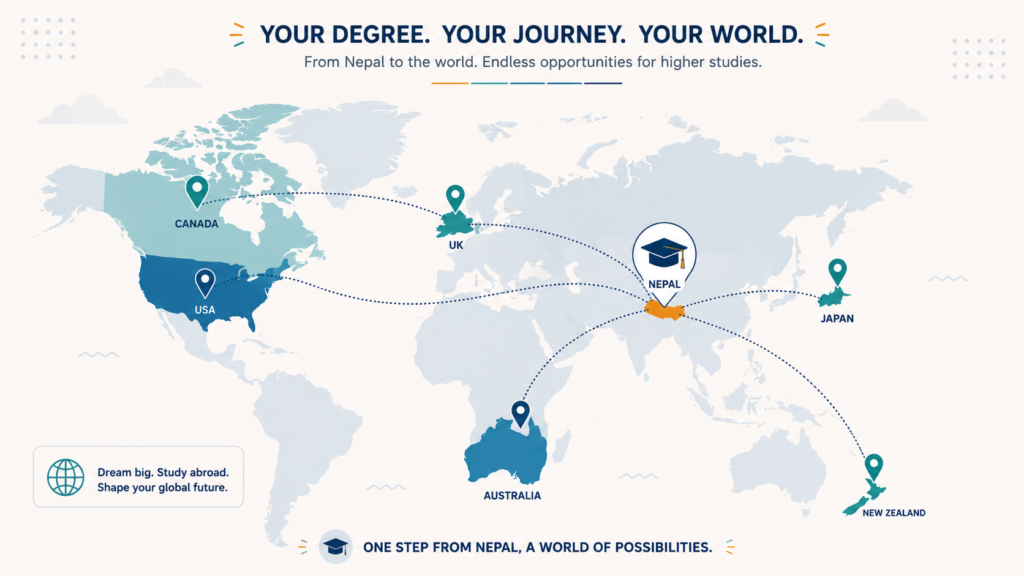
BCA doesn’t have to be your final degree. A growing number of Nepali graduates use it as a launchpad for a master’s abroad — better job markets, higher salaries, and often a path to permanent residency. Here’s what BCA higher studies abroad actually looks like: the countries, programs, and requirements.
Why Consider Higher Studies Abroad After BCA
International higher studies improve career opportunities through international exposure, technical expertise, and networking. Post-study work visas from countries like Canada and Australia also enable graduates to gain international work experience — and in many cases, a realistic path toward long-term settlement.
What You Can Study Abroad After BCA
Once BCA is complete, common higher study options overseas include a Master’s in Computer Science, Data Science, Artificial Intelligence, Cybersecurity, or an MBA in IT Management.
Best Countries for BCA Graduates
Canada
Canada offers a 3-year Post Graduation Work Permit (PGWP) and a clear pathway to Permanent Residency, making it one of the most popular choices among Nepali graduates seeking long-term settlement.
Australia
Australia provides strong wages and 2-4 years of post-study work options, and is considered one of the best countries for salary and lifestyle among Nepali students studying abroad.
United Kingdom
UK bachelor’s-to-master’s pathways are often shorter than equivalent programs elsewhere, and the Graduate Route visa allows 2 years of post-study work, making it attractive for students who want a globally recognized degree with less time investment.
United States
The USA leads in research opportunities, making it a strong choice for students interested in advanced technical specialization or eventual PhD study.
Germany
Germany offers nearly free education, a significant cost advantage for students focused on affordability without compromising on program quality.
General Requirements for Studying Abroad After BCA
Most universities in the USA, Canada, Australia, Germany, and the UK require standardized tests such as GRE or GMAT along with an English proficiency test like IELTS or TOEFL. Beyond test scores, universities typically look for:
- A completed four-year bachelor’s degree (BCA’s current 4-year structure meets most international credit requirements)
- Statement of purpose and letters of recommendation
- Relevant academic transcripts and mark sheets
- Proof of financial capability or scholarship/assistantship offers
Funding Your Studies Abroad
Scholarships and assistantships are commonly available to help cover tuition costs, particularly for research-oriented master’s programs. It’s worth researching university-specific scholarships early, since application deadlines for funding often come before the general admission deadline.
Is Studying Abroad the Right Move for You?
Higher studies abroad make the most sense if you’re aiming for advanced technical specialization, better long-term salary potential, or a realistic path to international settlement. If your goal is simply entering Nepal’s IT job market quickly, a strong BCA portfolio and internship may serve you just as well without the added cost and time investment of a master’s abroad.
Final Thoughts
BCA opens a real door to studying abroad, particularly for master’s programs in computer science, data science, and IT management. Canada and Australia stand out for post-study work and PR pathways, the UK for shorter degree timelines, the US for research depth, and Germany for cost. Whichever direction you choose, start preparing your English test scores and target university research well ahead of your final BCA semester.
Still deciding between working locally or studying abroad? Check our BCA career scope guide to compare local job opportunities first.