

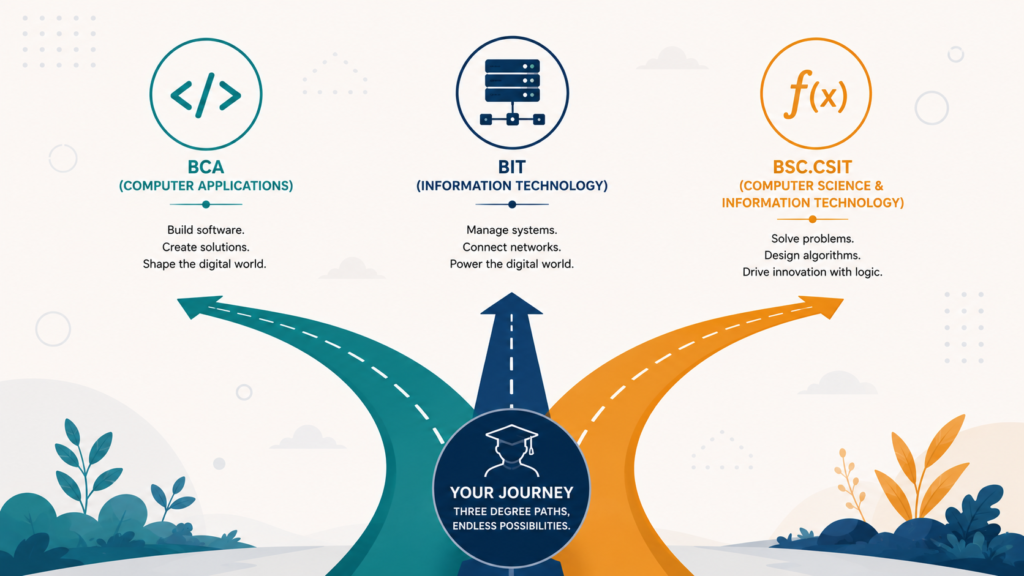
Every year after +2 results, thousands of students hit the same wall: BCA, BIT, or CSIT? All three are four-year, eight-semester programs under Tribhuvan University, all lead to careers in technology, and each gets called “the best one” by a different senior or counselor. The truth is, they’re genuinely different programs designed for different kinds of students.
The Core Difference in One Line
BSc CSIT is more theoretical and research-based, while BIT is more focused on practical IT skills like system management, cybersecurity, and handling real-world IT projects. BCA sits in between — practical and application-focused, but without CSIT’s heavy math and theory load.
BCA: Best for Practical, Application-Focused Learners
BCA focuses on practical computer applications, software development, web development, and databases. It is open to students from all +2 streams and is explicitly designed to produce job-ready software developers and IT professionals.
Choose BCA if: You want hands-on programming and software skills without a heavy math/theory focus, and you’re coming from any +2 stream (Science, Management, or Humanities).
BIT: Best for IT Systems and Infrastructure
BIT focuses more on IT systems, networking, IT infrastructure, databases, and how organizations manage technology. BCA tends to be more development-oriented while BIT is more IT-systems-oriented.
Choose BIT if: You’re more interested in how organizations manage and secure technology infrastructure than in writing application code all day.
CSIT: Best for Math-Heavy, Theory-Driven Students
CSIT teaches “how to build computers,” while BIT teaches “how to use computers and networks in business.” CSIT suits students who enjoy maths and computer science theory, and it’s the clearly stronger credential for students planning an MS in Computer Science abroad, since foreign universities recognize its science-heavy curriculum and credit transfer is well-established. + 2
Choose CSIT if: You genuinely enjoy mathematics and algorithmic thinking, and you’re considering research or graduate study in computer science.
Career Outcomes: Does It Actually Matter Which One You Pick?
Not as much as students assume, once you’re a few years in. For web development, mobile apps, and digital marketing roles, employers don’t automatically consider CSIT better than BCA or BIT — whoever has the stronger portfolio of work samples gets the offer. Starting salaries for strong candidates from any of the three typically fall in the Rs. 30,000 to Rs. 50,000 range.Nacolnist
The one area where the degree name genuinely matters is graduate study abroad — CSIT’s science-heavy curriculum gives it an edge for MS programs in the US, Canada, Australia, and UK.
Comparison at a Glance
| Factor | BCA | BIT | CSIT |
| Focus | App/software development | IT systems & infrastructure | Computer science theory |
| Math intensity | Low-moderate | Moderate | High |
| Open to all +2 streams | Yes | Mostly | Usually Science stream preferred |
| Best for | Practical developers | IT/network management | Research, grad study abroad |
| Career flexibility | High | High | High, plus strong grad-school edge |
How to Actually Decide
- If math stresses you out — lean toward BCA
- If you’re drawn to networks, servers, and IT security — lean toward BIT
- If you enjoy algorithms and want to study abroad for a master’s — lean toward CSIT
- If you’re still unsure — BCA offers the widest entry accessibility and strong practical outcomes, making it a safe, flexible default for most students
Final Thoughts
There’s no universally “best” choice among BCA, BIT, and CSIT — only the best fit for your interests and goals. If you want practical, job-ready skills without a heavy math load, BCA remains the most accessible and flexible option. If theory and international graduate study are your priority, CSIT has the edge. And if you’re drawn to systems and infrastructure, BIT is worth serious consideration.
Already leaning toward BCA? Check our full course overview to see exactly what the four years look like.