

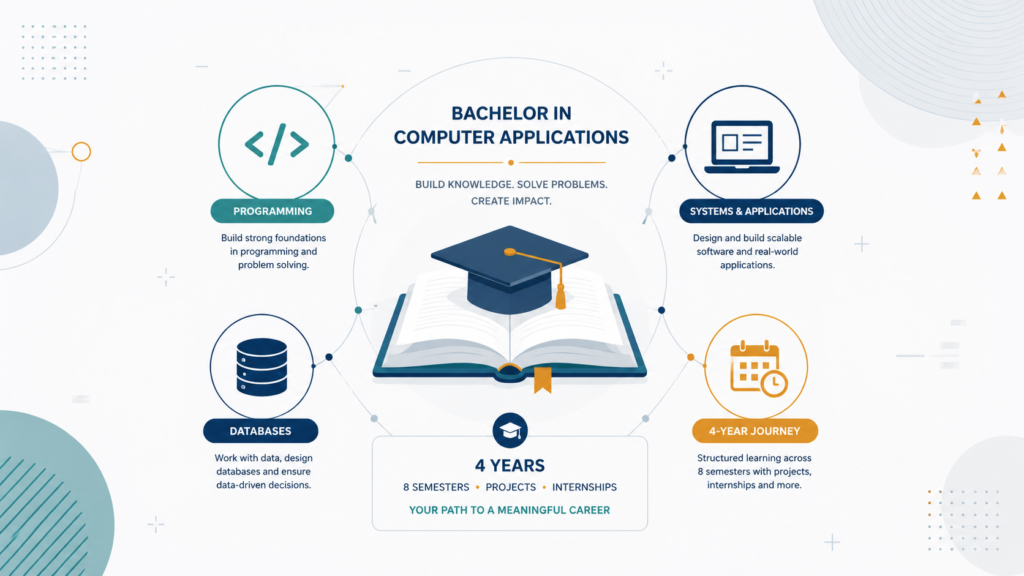
Thinking about enrolling in BCA but want the full picture before you commit four years? This BCA course overview in Nepal breaks down everything at a glance — course structure, subjects, fees, top colleges, and how it compares to similar degrees.
Whether you’re a student deciding between BCA, BIT, or CSIT, or a parent trying to understand what this degree actually involves, this guide covers the essentials in one place.
Quick Facts: BCA Course Overview
Here’s the snapshot before we go deeper:
| Detail | Information |
| Full Form | Bachelor of Computer Application |
| Affiliated University | Tribhuvan University, Faculty of Humanities and Social Sciences (FOHSS) |
| Duration | 4 years, divided into 8 semesters |
| Total Credit Hours | 126 credit hours (2,016 lecture hours total) |
| Medium of Instruction | English |
| Eligibility | 10+2 or equivalent from any stream (Science, Management, or Humanities) |
| Colleges Offering BCA | 127 institutions across Nepal, with 64 in Kathmandu district |
| Total Annual Seats | Approximately 4,500 seats |
| Admission Process | Entrance exam via Central Examination Board (CEB) |
Course Structure: How BCA Is Organized
BCA follows a semester system rather than yearly exams, which means you’re assessed twice a year instead of once. The program totals 126 credit hours, with students required to study 96 credit hours of computer-related subjects — including core courses, electives, and internships.
The four years generally progress like this:
Year 1 (Semesters 1-2): Foundations
Basic programming logic, mathematics, computer fundamentals, and communication skills. This year is designed to bring students from all academic backgrounds — Science, Management, or Humanities — onto the same footing.
Year 2 (Semesters 3-4): Core Programming
Object-oriented programming, data structures, database management systems, and statistics. This is typically where students start specializing in how they think about problem-solving.
Year 3 (Semesters 5-6): Applied Technology
Web technologies, software engineering, networking, and mobile application development, alongside electives that let students start narrowing toward their interests.
Year 4 (Semesters 7-8): Specialization & Project
Advanced electives (commonly covering areas like cloud computing, AI, or cybersecurity), a major final-year project, and a mandatory internship to build real-world experience before graduation.
Eligibility: Who Can Enroll?
You don’t need a Science background to enroll in BCA — since it falls under TU’s Faculty of Humanities and Social Sciences, students from any stream can apply. The general requirements are:
- Completion of 10+2 or an equivalent qualification from a recognised institution
- A minimum D grade in each subject of grades 11 and 12, with a CGPA of 1.8 or above
- Minimum second-division marks in 10+2, PCL, or equivalent
Admission Process Overview
Getting in requires clearing the TU BCA entrance exam, conducted by the Central Examination Board. The general steps:
- Submit the online application and pay the entrance fee via eSewa or Khalti
- Get the form approved by your target constituent/affiliated college
- Print your admit card before the exam
- Sit for the written entrance test at your assigned center
- Check results online — results are published digitally only, with no postal notifications
TU typically opens applications once a year, usually starting in Shrawan–Bhadra (July–August).
BCA Course Fees in Nepal
Fee structures vary widely depending on whether you choose a constituent campus or a private college. Private colleges generally range from roughly NPR 50,000 to NPR 2,00,000 for the full course, with premium colleges charging on the higher end. Constituent campuses tend to be significantly more affordable, though seats there are more competitive. Always verify current fee structures directly with individual colleges, since they’re revised periodically.
Where Can You Study BCA in Nepal?
With 127 institutions offering BCA across Nepal and 64 of them concentrated in the Kathmandu district, students have a wide range of choices — from long-established constituent campuses to newer private colleges with modern labs and industry partnerships. When shortlisting, look beyond just the fee structure: check faculty experience, lab infrastructure, internship placement support, and alumni outcomes.
BCA vs BIT vs CSIT: How Does It Compare?
A common point of confusion for students is choosing between BCA, BIT, and CSIT. Here’s a quick distinction:
- BCA — Broader, application-focused; suitable for students from any academic stream; strong on programming and software development fundamentals
- BIT — More technically rigorous with heavier emphasis on IT infrastructure and systems
- CSIT — Science-stream only, more theoretical and research-oriented, closer to a traditional computer science degree
If you want a practical, industry-ready path into software or web development without needing a Science background, BCA is usually the more accessible choice.
Career Outlook After BCA
BCA graduates commonly move into software development, web development, database administration, networking, and IT support roles. Nepal’s IT exports crossed one billion dollars in 2025, and demand for trained computer graduates continues to grow, making this a reasonably future-proof degree if you build real project experience alongside your coursework.
Final Thoughts
BCA in Nepal offers a well-rounded, four-year path into the IT industry — accessible to students from any academic background, backed by a structured semester system, and recognized by 127+ colleges nationwide. If you’re weighing your options, the next step is shortlisting colleges based on fees, location, and internship support, then preparing thoroughly for the TU entrance exam.
Ready to start comparing colleges or prepping for the entrance exam? Explore our detailed guides to take the next step with confidence.