

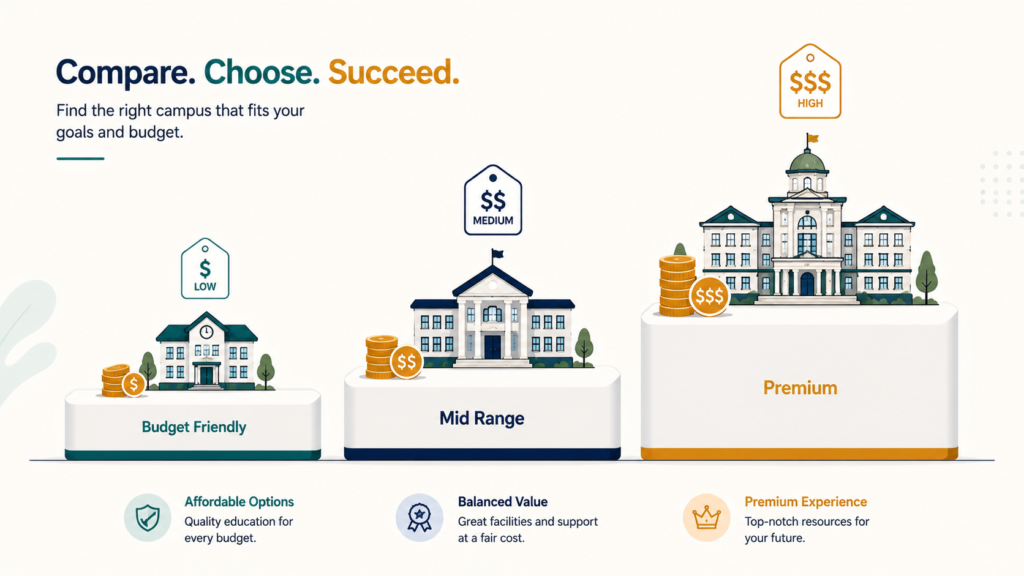
Fee structure is often the single biggest factor in choosing a BCA college in Nepal — and it varies far more than most students expect. A BCA fee structure can range from around NPR 3 lakhs at a government campus to well over NPR 8 lakhs at a premium private college.
This guide breaks down exactly what you’ll pay depending on the type of institution you choose, plus the extra charges that often catch students off guard.
BCA Fee Structure by College Type
Tuition fees for BCA vary considerably depending on whether you enroll in a constituent campus, a community college, or a private institution.
Constituent (Government) Campuses
Constituent campuses of Tribhuvan University offer the most affordable option, with total program costs generally ranging from approximately Rs. 3 to 4 lakhs for the full four-year program. These are government-subsidized, which keeps costs significantly lower than private alternatives.
As a real example, one government campus lists a total BCA fee of NPR 3,50,000, with extra charges for uniform (NPR 10,000), orientation (NPR 5,000), campus exam (NPR 1,000), TU board exam form (NPR 2,500), and viva (NPR 1,500) on top of the base fee.
Community Colleges
Community colleges typically charge slightly higher fees than constituent campuses, while remaining significantly more affordable than most private colleges. They sit in the middle ground — a good option if you want somewhat better facilities without the full private-college price tag.
Private Colleges
Private colleges offer the widest range of pricing and the most flexibility in fee structures. Based on fee structures across several TU-affiliated colleges, the overall cost of completing a BCA program at private institutions generally ranges from Rs. 5 lakhs to Rs. 8 lakhs, depending on the college, facilities, and services included. Some sources place the range even wider — from NPR 400,000 to NPR 850,000 for the entire four-year duration, depending on the specific institution and its infrastructure.
Why the Price Gap Is So Large
The difference between government and private fees comes down to a few consistent factors:
- Government subsidy — constituent campuses receive public funding, keeping student costs low
- Infrastructure and facilities — private colleges often invest more in labs, buildings, and technology
- Batch size — private colleges commonly offer smaller class sizes and more individual attention
- Industry exposure — private colleges tend to offer more industrial exposure and partnerships than constituent colleges typically provide
- Brand and location — colleges in prime urban locations with established reputations often charge a premium
Additional Charges Beyond Tuition
Base tuition rarely covers everything. Budget for these commonly separate charges:
- Admission fee (paid at enrollment)
- Uniform costs (if compulsory at your college)
- Orientation fee
- Campus/internal exam fees
- TU board exam form fees (paid separately each semester)
- Viva/practical exam fees
- Lab and library fees (at some institutions)
TU board exam fees and viva fees are commonly listed as separate from the base fee structure, so always ask for the full itemized cost before enrolling — not just the headline tuition figure.
How Fee Payment Usually Works
You generally don’t need to pay the full course fee upfront. Colleges typically require an admission fee at the time of enrollment, followed by semester-wise or year-wise payments, and it’s very common for colleges to allow fee payment in installments. Exact payment terms vary by institution, so confirm the schedule directly with your chosen college.
Scholarships and Fee Reductions
Many colleges — especially private ones — offer scholarships to reduce the financial burden. Some private colleges give scholarships ranging from 30% to 75% of tuition costs based on GPA, along with free entrance test coaching for prospective students. Government colleges also extend scholarships to students who graduated from government schools or come from marginalized backgrounds, further improving accessibility. Some constituent campuses reserve scholarships for up to 10% of enrolled students.
Always ask each shortlisted college directly about their current scholarship policy — most colleges list this on request even if it isn’t advertised prominently.
Quick Fee Comparison Snapshot
| College Type | Approximate Total Cost (4 years) | Notes |
| Constituent (Government) Campus | NPR 2.5 – 4 lakhs | Most affordable; limited seats, competitive entry |
| Community College | Slightly above constituent | Middle-ground pricing and facilities |
| Private College | NPR 5-8 lakhs (some as low as ~4 lakhs) | Wide variation; better infrastructure and industry exposure |
Tips for Budgeting Your BCA Education
- Get the full itemized fee sheet — not just tuition, but exam fees, uniform, and other add-ons
- Ask about scholarship eligibility upfront, especially if you have a strong academic record
- Compare 3-4 colleges within your budget range before deciding
- Confirm installment options if paying the full fee at once isn’t feasible
- Factor in non-academic costs like transportation, books, and living expenses if you’re relocating for college
Final Thoughts
BCA fee structures in Nepal span a wide range, and the right choice depends on your budget and priorities — affordability at a constituent campus, or better infrastructure and industry exposure at a private college. Whichever route you choose, always request a complete cost breakdown before enrolling, and don’t skip asking about scholarships.
Still deciding which college fits your budget? Check our full course overview guide to compare colleges alongside their academic structure.