

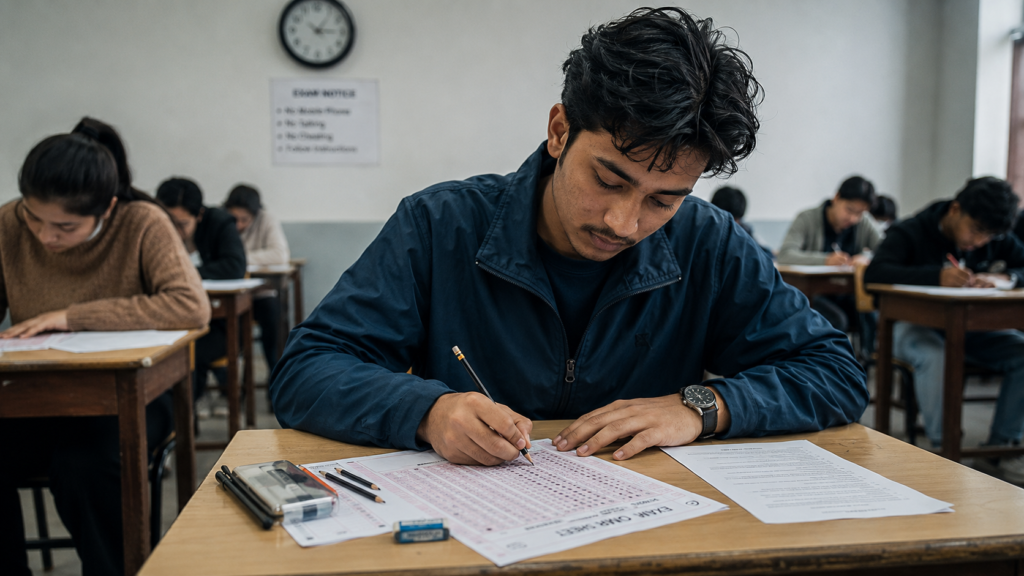
Clearing the BSc CSIT entrance exam is the single biggest hurdle between a science-stream +2 graduate and a seat at a top computing college in Nepal. It’s competitive rather than conceptually difficult — the questions stay within your +2 syllabus, but the format rewards speed and accuracy over depth.
This BSc CSIT entrance exam guide covers the exam pattern, syllabus breakdown, important dates, and a practical preparation strategy to help you walk in confident and walk out with a strong score.
What Is the BSc CSIT Entrance Exam?
The BSc CSIT Entrance Exam is a national-level test conducted by Tribhuvan University’s Institute of Science and Technology (TU IOST). It’s the mandatory gateway exam for any student wanting to study Computer Science and Information Technology (CSIT) at TU-affiliated colleges — and since many students from all over the country compete for a limited number of seats, it’s a genuinely competitive step in the admission process.
You cannot enroll in any BSc CSIT college, government or private, without clearing this exam first.
Exam Pattern and Marking Scheme
The exam follows a straightforward but fast-paced structure:
- Total marks: 100
- Question type: Fully objective (MCQ), each question carrying 1 mark
- Duration: 2 hours (120 minutes)
- Negative marking: None — you can attempt all 100 questions without penalty for wrong answers
- Pass mark: 35 out of 100
The 100 questions are divided into five subject sections:
| Subject | Marks |
| Mathematics | 25 |
| Physics | 25 |
| Chemistry (or Biology) | 25 |
| General IT | 10 |
| English | 15 |
Because admission is rank-based rather than simple pass/fail, the official pass mark of 35 is only a minimum threshold — the actual cutoff for a seat at a specific college is typically much higher and varies by year and campus.
Syllabus Breakdown
The entrance syllabus is based on the NEB Grade 11 and 12 Science curriculum, plus basic information technology concepts. Here’s what to expect in each section:
Mathematics
- Mainly focused on the Grade 11 syllabus
- Widely considered the most scoring — and most critical — section, since it carries the heaviest calculation load
Physics
- Mechanics, heat and thermodynamics, waves and sound, optics, electricity and magnetism, and modern physics
- Drawn from both Grade 11 and 12 content
Chemistry or Biology
- Students can be tested on either Chemistry or Biology topics from Grades 11 and 12, depending on their stream background
English
- Grammar, comprehension, and vocabulary from the Grades 11–12 syllabus
Computer Knowledge
- Basic IT concepts, general computer literacy, and fundamental technology awareness — this section rewards broad familiarity more than deep technical knowledge
Important Dates and Fees to Know
Entrance exam applications open only once a year, so missing the window means waiting a full year to reapply. For the 2083 (2026) session:
- Application opens: Around mid-to-late Ashadh (June 2026)
- Normal fee submission deadline: Early Shrawan (early August 2026)
- Late fee window: A short extension period with a doubled fee
- Exam date: Early-to-mid Shrawan/Bhadra (around August 2026)
- Normal form fee: Approximately Rs. 1,950
- Late form fee: Roughly double the normal fee
Because exact dates shift slightly each year, always cross-check the current cycle’s dates on the official TU IOST notice before finalizing your study plan.
How to Prepare: A Practical Strategy
Shifting from board exams to an MCQ-based entrance exam requires a real mindset shift. Board exams reward step-by-step methodology; this exam rewards speed and accuracy under time pressure.
1. Prioritize Mathematics first.
Since Math is widely regarded as the most critical and scoring subject, build your study schedule around mastering Grade 11 Math topics before anything else.
2. Build a structured multi-week plan.
A focused 6–8 week preparation window is enough for many students, provided it’s consistent. A simple structure looks like:
- Weeks 1–2: Concept revision across all five subjects
- Week 3: Topic-wise practice sets, focusing on weak areas
- Week 4: Full-length mock tests, past papers, and doubt-clearing sessions
3. Practice with past papers.
Solving previous years’ entrance question sets helps you recognize question patterns and question difficulty far better than fresh textbook problems alone.
4. Take timed mock tests.
Since the format rewards speed, simulate real exam conditions — a strict 2-hour timer, no interruptions — at least 5–6 times before the actual exam.
5. Use a “sweep” strategy on exam day.
Don’t get stuck on any single question for too long. Aim to answer easier theoretical questions (English, computer knowledge, and simpler chemistry/biology items) quickly, saving extra time for calculation-heavy Math and Physics questions.
Common Mistakes to Avoid
- Ignoring Computer Knowledge and English because they “feel easy” — every mark counts toward your final rank
- Studying outdated syllabus versions instead of the current year’s official syllabus
- Skipping full mock tests and only doing topic-wise practice, which leaves you unprepared for the actual time pressure
- Missing the normal fee deadline and paying an avoidable late fee
After the Exam: What Happens Next
Once results are published, admission isn’t automatic — your combined entrance score and +2 academic performance determine your merit rank, which in turn determines which colleges and quota category you’re eligible for. Higher-ranked students get priority access to more competitive, in-demand colleges, so your entrance score directly shapes your options.
Conclusion
The BSc CSIT entrance exam isn’t designed to trip you up with obscure content — it tests how well you know your +2 Science syllabus under real time pressure. With a structured study plan, heavy focus on Mathematics, and consistent mock-test practice, most well-prepared students can score comfortably above the college cutoffs they’re targeting.
Start early, follow the official TU IOST syllabus strictly, and treat your final weeks before the exam as pure practice-and-review time rather than new-content learning.