

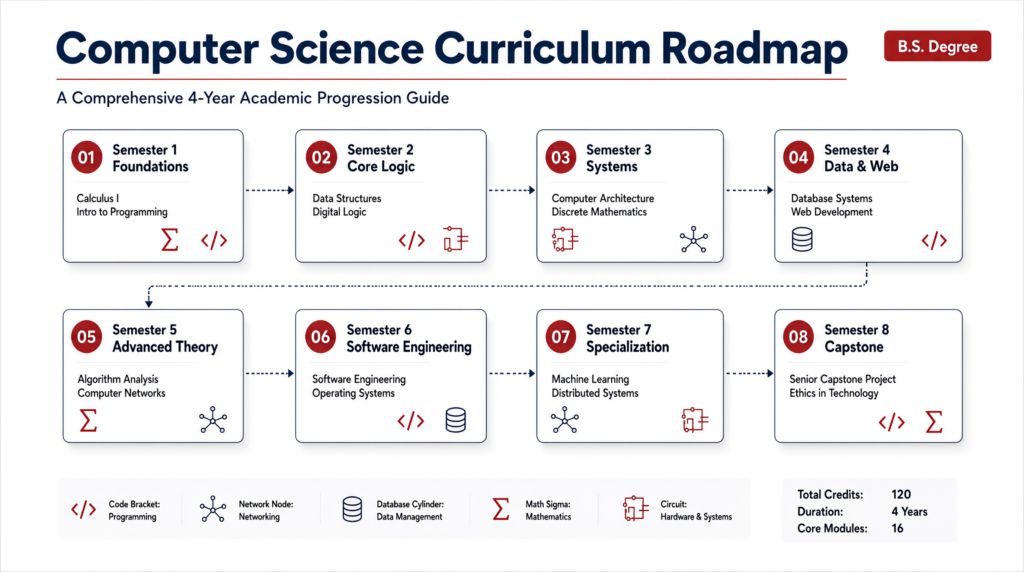
Trying to figure out exactly what you’ll study in each year of BSc CSIT? This complete BSc CSIT subjects list, broken down semester-wise, gives you a clear picture of the curriculum — from your very first C programming class to your final-year project and internship.
Note that Tribhuvan University periodically revises subject names and electives, so always cross-check the current syllabus with TU IOST or your college before exam preparation. Here’s the well-established structure most students follow across the 126-credit, 8-semester program.
BSc CSIT Curriculum at a Glance
The BSc CSIT program blends five broad course categories across its 126 credit hours:
- Computer science core courses
- Mathematics courses
- Natural science electives
- English courses
- Social science and management courses
- Computer science electives
- Final-year project and internship
This mix is what gives CSIT graduates both strong theoretical computer science grounding and applied, industry-relevant skills.
Semester 1 Subjects
- Introduction to Information Technology
- Programming in C
- Probability and Statistics
- Calculus and Analytical Geometry
- Physics
This semester lays the foundation — you’re introduced to computing concepts, structured programming, and the math background you’ll rely on for the rest of the degree.
Semester 2 Subjects
- Digital Logic
- Discrete Structure
- Microprocessor
- Data Structures and Algorithms
- Linear Algebra
Semester 2 shifts toward core computer science thinking, particularly data structures — a subject that becomes the backbone of almost every later programming course.
Semester 3 Subjects
- Computer Architecture
- Object Oriented Programming Language
- Operating Systems
- Numerical Method
- Introduction to Management
Here you move from foundational programming into more structured, object-oriented thinking, alongside your first real look at how operating systems work.
Semester 4 Subjects
- Theory of Computation
- Computer Networks
- Operating System (continued/advanced)
- Database Management System
- Artificial Intelligence
Semester 4 is often considered a turning point — this is where networking, databases, and your first formal introduction to AI enter the curriculum.
Semester 5 Subjects
- Design and Analysis of Algorithms
- System Analysis and Design
- Cryptography
- Simulation and Modelling
- Web Technology
- Elective I (options often include Multimedia Computing, Wireless Networking, Image Processing, or Knowledge Management)
This is your first semester with an elective, letting you start specializing based on interest — security, multimedia, or systems design.
Semester 6 Subjects
- Software Engineering
- Compiler Design and Construction
- E-Governance
- NET Centric Computing
- Technical Writing
- Elective II (options often include Applied Logic, E-Commerce, Automation and Robotics, Neural Networks, or Cognitive Science)
Software Engineering is a major highlight here, teaching the structured development practices you’ll use directly in your final-year project.
Semester 7 Subjects
- Advanced Java Programming
- Data Warehousing and Data Mining
- Principles of Management
- Project Work (Part I)
- Elective III (options often include Information Retrieval, Database Administration, Software Project Management, or Network Security)
This is where your final-year project officially begins, alongside more advanced, application-oriented programming and data topics.
Semester 8 Subjects
- Advanced Database
- Internship
- Elective IV (options often include Cloud Computing, Mobile Application Development, Distributed and Object-Oriented Database, or Network and System Administration)
Your final semester wraps up the project component and requires a mandatory internship, giving you real-world workplace exposure before graduation.
Full Semester-Wise Subjects Table
| Semester | Key Subjects |
| 1 | Intro to IT, Programming in C, Probability & Statistics, Calculus, Physics |
| 2 | Digital Logic, Discrete Structure, Microprocessor, Data Structures & Algorithms, Linear Algebra |
| 3 | Computer Architecture, OOP, Operating Systems, Numerical Method, Intro to Management |
| 4 | Theory of Computation, Computer Networks, Operating Systems, DBMS, Artificial Intelligence |
| 5 | Algorithms Design & Analysis, System Analysis & Design, Cryptography, Simulation & Modelling, Web Technology, Elective I |
| 6 | Software Engineering, Compiler Design, E-Governance, NET Centric Computing, Technical Writing, Elective II |
| 7 | Advanced Java, Data Warehousing & Mining, Principles of Management, Project Work, Elective III |
| 8 | Advanced Database, Internship, Elective IV |
Understanding the Elective System
One of the more flexible parts of the BSc CSIT curriculum is its elective structure, spread across semesters 5 through 8. Each elective slot typically offers a shortlist of options, letting students lean toward areas like:
- Networking and security: Wireless Networking, Network Security, Advanced Networking
- Data and AI: Image Processing, Neural Networks, Data Mining
- Systems and infrastructure: Cloud Computing, Distributed Databases, System Administration
- Applications: Mobile Application Development, Game Technology, E-Commerce
Since elective availability can vary by college, it’s worth checking with your specific institution about which options they actually offer each year.
Practical and Project Components
Nearly every core theory subject in the BSc CSIT curriculum is paired with a hands-on lab component, reinforcing classroom learning with real coding, networking, and database practice. The program builds toward two major applied milestones:
- The Project Work, started in semester 7 and typically completed by semester 8, where students design and build a substantial software solution
- The Internship, a mandatory component in semester 8 that places students in real IT workplace environments
Conclusion
This semester-wise BSc CSIT subjects list shows a curriculum that steadily builds from programming fundamentals and mathematics in year one toward specialized electives, a capstone project, and an internship by year four. Understanding this progression early helps you plan your study priorities and even start thinking about which electives align with your career interests.
For the most accurate, currently examinable subject list, always refer to the latest official syllabus published by TU IOST or your college’s academic office before each semester begins.