

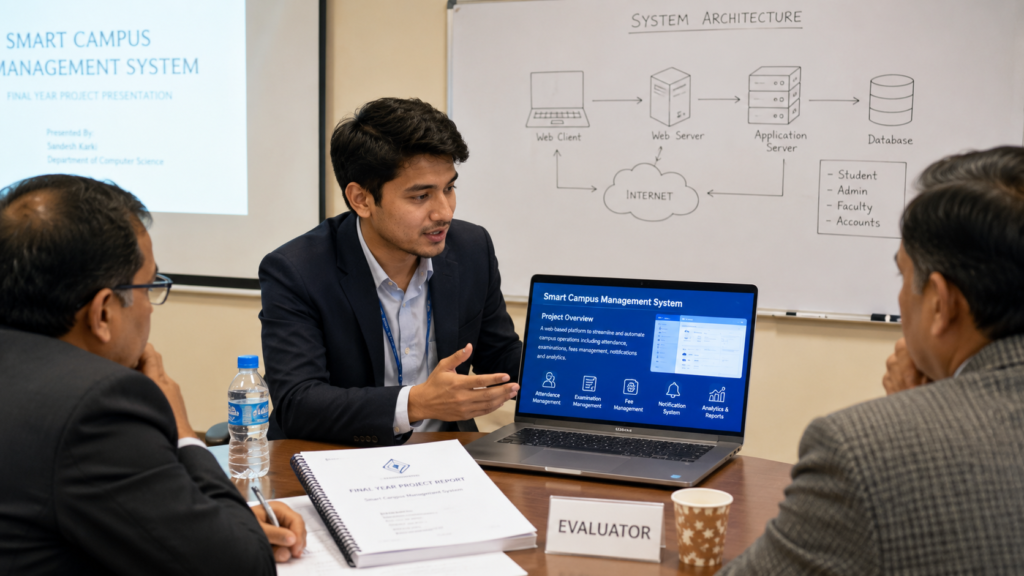
Your final year project is more than just a graduation requirement — it’s often the single most important thing on your resume when you’re applying for your first IT job. A well-executed project can outweigh grades in interviews.
This guide covers strong final year project ideas for BIT students, organized by domain, along with tips on choosing and executing a project that actually helps your career.
Why Your Final Year Project Matters
Your project is typically the first substantial, self-directed piece of software you build — and it’s proof to employers that you can take an idea from concept to working product, not just complete assigned coursework.
Along with technical courses that take care of theory, final year projects let students put their creative and practical skills to the test, incorporating intellectual understanding with practical problem-solving for real-world solutions.
Web Development Project Ideas
- School/College Management System — student records, attendance, grading, and fee tracking in one platform.
- E-Commerce Platform — product listings, cart, checkout, and admin dashboard for inventory management.
- Job Portal — connecting job seekers and employers with resume uploads and application tracking.
- Hospital/Clinic Management System — appointment booking, patient records, and billing.
- Library Management System — book tracking, member management, and fine calculation.
Mobile Application Project Ideas
- Local Service Booking App — connecting users with local service providers (electricians, tutors, cleaners).
- Campus Event/Notice App — centralized notifications and event management for a college.
- Expense Tracker App — personal finance tracking with visual spending breakdowns.
- Food Delivery/Ordering App — for a local restaurant or a small delivery network.
AI and Machine Learning Project Ideas
- Plagiarism Detection Tool — text similarity checking for academic submissions.
- Face Recognition Attendance System — automating classroom or office attendance using computer vision.
- Chatbot for Customer Support — a rule-based or ML-driven chatbot for a specific business use case.
- Sentiment Analysis Tool — analyzing customer reviews or social media comments for sentiment trends.
Networking and Systems Project Ideas
- Network Monitoring Dashboard — visualizing bandwidth usage and detecting anomalies across a small network.
- Simple VPN or Secure Tunnel Implementation — demonstrating understanding of encryption and secure communication.
- IoT-Based Home/Office Automation System — combining hardware sensors with a software dashboard.
- Network Intrusion Detection System (Basic) — flagging suspicious traffic patterns using simple rule sets.
Cybersecurity Project Ideas
- Password Strength and Breach Checker — evaluating password security against common attack patterns.
- Secure File Sharing System — implementing encryption for file transfer between users.
- Phishing Website Detector — using URL pattern analysis to flag potentially malicious sites.
How to Choose the Right Project
- Align with your career direction — if you want a cybersecurity job, build a security-focused project rather than a generic web app.
- Pick something you can realistically finish — an ambitious idea that’s only 60% complete by submission looks worse than a simpler, fully functional project.
- Solve a real, specific problem — projects built for an actual local business or community need (like a local shop’s inventory system) tend to stand out more than generic tutorials-based ideas.
- Check feasibility with your available tools and skills — don’t pick a machine learning project if you haven’t built confidence with basic ML concepts yet.
Tips for Executing a Strong Project
- Start early — ideally by semester 6, so you have time to research, plan, and build without last-minute pressure.
- Write a clear proposal first — define the problem, scope, and technology stack before writing any code.
- Build incrementally — get a basic working version early, then add features, rather than trying to build everything at once.
- Document as you go — keep notes on design decisions and challenges; this makes your final report much easier to write.
- Test thoroughly before submission — a project that crashes during your demo undermines even strong underlying work.
- Prepare a clear, confident presentation — practice explaining your project’s purpose, architecture, and key features in simple terms.
Common Mistakes to Avoid
- Choosing an overly ambitious scope that can’t realistically be completed within the semester timeline.
- Copying a tutorial project without adding original features or a real use case.
- Neglecting documentation until the last week, resulting in a rushed, unclear final report.
- Skipping testing, leading to bugs surfacing during the evaluation presentation.
- Not aligning the project with your intended career path, missing an opportunity to strengthen your portfolio for job applications.
Conclusion
A strong final year project can do more for your career than an extra semester of good grades — it’s tangible proof of what you can actually build. Choose a project aligned with your career goals, keep the scope realistic, and start early enough to build, test, and document properly.
Once you’ve picked a direction, treat your project like a real portfolio piece, not just an assignment to pass. Want to make sure your project timeline fits around other final semester demands? Check out our internship guide for BIT students to plan both alongside each other.