

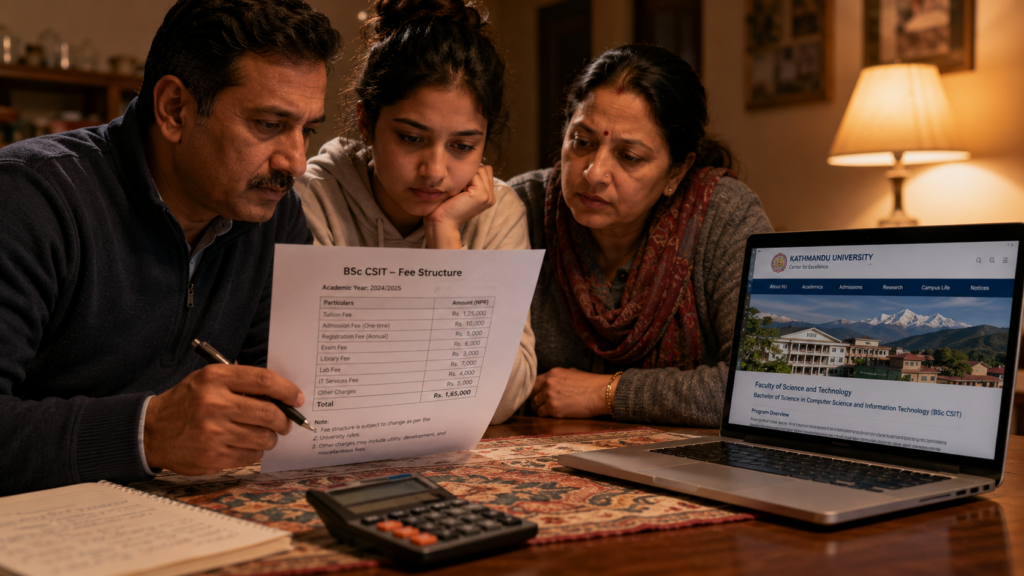
Choosing a BIT college in Nepal isn’t just about rankings or location — cost is often the deciding factor for most families. And the gap between a government-run campus and a private college can be significant, sometimes doubling or tripling your total expense.
This guide breaks down the BIT fee structure in Nepal, covering constituent campuses, private colleges, semester-wise costs, hidden charges, and scholarship options, so you can plan your budget realistically before you apply.
BIT Fees at TU Constituent Campuses
Constituent campuses — the government-run colleges directly operated by Tribhuvan University — offer the most affordable route into the BIT program.
The fee structure of the BIT program at Tribhuvan University’s constituent colleges is around NPR 3.5 lakhs for the entire course, and since the program is available only at TU’s constituent colleges, similar fee structures apply across most of them.
For a more specific example: at Patan Multiple Campus, one of TU’s constituent campuses, students pay an admission fee of NPR 95,000, with the total fee for the complete eight-semester BIT program coming to approximately NPR 375,000.
Why are constituent campus fees so much lower than private colleges? Constituent (public) campuses receive government subsidies through the University Grants Commission (UGC), while private affiliated colleges run entirely on tuition and their own income without regular public operating subsidies — which is one direct reason private college fees tend to be higher.
BIT Fees at Private/Affiliated Colleges
Private TU-affiliated colleges, particularly those in Kathmandu Valley, charge considerably more due to added infrastructure, facilities, and lack of government subsidy.
Based on patterns seen in comparable IT programs like BCA at private colleges, private affiliated colleges — depending on physical infrastructure, modern labs, campus placement support, and other facilities — generally charge in the range of NPR 600,000 to 800,000 for the full course, compared to NPR 300,000–400,000 at government constituent campuses.
For BIT specifically, expect a similar pattern: fees at private colleges commonly fall between NPR 6–9 lakhs, with some Kathmandu Valley institutions charging even more depending on lab quality, faculty, and placement support.
BIT Fees Under Pokhara University (PU)
Pokhara University’s BIT program, offered through its affiliated schools and colleges, follows a different fee structure than TU.
As one reference point, PU’s School of Science & Technology has published a Full Fee (Open Category) of around NPR 344,200 for its BIT program — though this figure applies specifically to that school and isn’t representative of every PU-affiliated college.
Since each campus publishes its own schedule along with any additional lab, library, or exam charges, it’s important to check the specific fee sheet for the college you’re applying to rather than assuming a single flat number applies everywhere.
What’s Usually Included (and What’s Not)
The advertised “total fee” doesn’t always tell the whole story. Your actual bill typically includes several separate line items:
- Tuition, labs, libraries, exams, student funds, and caution deposits — and sometimes fieldwork or additional charges — are all typically itemized separately rather than bundled into one number.
- University examination and registration fees may not be fully included in the headline tuition figure; Tribhuvan University generally charges around NPR 2,500 to 3,000 per semester as examination form fees.
Because of this, it’s worth requesting a full semester-wise breakdown before committing, rather than relying only on a college’s advertised total.
Sample Fee Comparison Table
| Institution Type | Approximate Total Fee (4 Years) |
| TU Constituent Campus (e.g., Patan Multiple Campus) | NPR 2.5–4 lakhs |
| TU Private/Affiliated College | NPR 6–9 lakhs |
| PU Affiliated School (varies by campus) | NPR 3.4–5+ lakhs |
| Additional per-semester exam fees (TU) | NPR 2,500–3,000/semester |
Note: These figures are indicative averages compiled from published campus data and can vary. Always confirm with the specific college’s official fee notice before applying.
Scholarships and Fee Waivers
Many BIT-offering colleges, especially constituent campuses, provide some form of financial support for eligible students.
Merit and reservation category scholarships appear in many admission notices, though it’s important to read the specific line items carefully — some scholarships cover tuition only, while others combine tuition with lab or exam fee waivers.
Some constituent campuses, such as Patan Multiple Campus, publicize merit-based fee reductions directly through their admission notices, tied to entrance exam performance.
If cost is a major factor in your decision, it’s worth directly asking the admissions office at your shortlisted colleges about available scholarships before ruling out a program based on the advertised fee alone.
Tips for Budgeting Your BIT Education
- Ask for a written, semester-wise fee breakup before making any payment — don’t rely only on verbal quotes or advertised totals.
- Clarify refund and installment policies upfront, since fee structures and payment terms vary between colleges.
- Factor in exam and registration fees separately, as these are often billed per semester rather than included in the headline tuition figure.
- Compare constituent vs. private options realistically — a constituent campus seat can save you several lakhs over four years, but competition for those seats is intense.
- Check for merit-based waivers tied to your entrance exam score, since scoring well can directly reduce your total cost at some colleges.
Conclusion
The BIT fee structure in Nepal varies dramatically depending on whether you study at a government constituent campus or a private affiliated college, with the gap often running into several lakhs of rupees over four years. Constituent campuses remain the most budget-friendly option, but competitive entrance exam performance is essential to secure one of the limited seats.
Before finalizing your college choice, request an official, itemized fee sheet directly from the admissions office, and check whether merit-based scholarships apply to your entrance exam score. Curious about what your entrance score needs to be competitive? Check out our complete BIT entrance exam guide to start preparing.